
The1903 Courthouse on Historic Route 66 in Waynesville, Missouri


THE 1903 COURTHOUSE: FROM FRONTIER JUSTICE TO ROUTE 66 WITNESS
by Jax Welborn

Pre-1920: When lightning struck Pulaski County's third courthouse on June 13, 1903, destroying the barely used brick building and most county records, officials turned to Missouri State Architect Henry H. Hohenschild to design its replacement. Working with local materials—bricks fired at Dr. Tice's farm (now Waynesville City Park)—contractors built a substantial 60-by-40-foot Romanesque Revival structure at a cost of $10,240. The building's distinctive red brick exterior, limestone foundation, and three-story tower made it one of Hohenschild's ten Missouri courthouse designs. Little did officials know this fourth courthouse would witness the transformation of Waynesville from a quiet Ozark county seat into a crossroads of American history.

The Route 66 Era (1926-1941): The courthouse's significance multiplied in 1926 when U.S. Highway 66 was commissioned directly past its front doors on the town square. When the road was paved in 1931, traffic surged through Waynesville, transforming the courthouse square into a vital stop on America's Main Street. The building stood witness to Route 66's golden age—travelers stopping to conduct county business, pay fines, or simply admire the architectural centerpiece of this Ozark community. Fort Leonard Wood's construction in 1941 brought another boom, with the courthouse serving a dramatically expanded population of military personnel and construction workers who flooded the county.
Preservation and Historic Recognition (1979-1990): As Route 66 faded into memory—decommissioned in 1985—preservationists recognized the 1903 courthouse's architectural and historical significance. The building earned National Register of Historic Places designation in 1979, becoming one of only six such sites in Pulaski County and one of just two period courthouses remaining on Missouri's Route 66. After 87 years of continuous service, county government operations moved to a new courthouse building in January 1990.
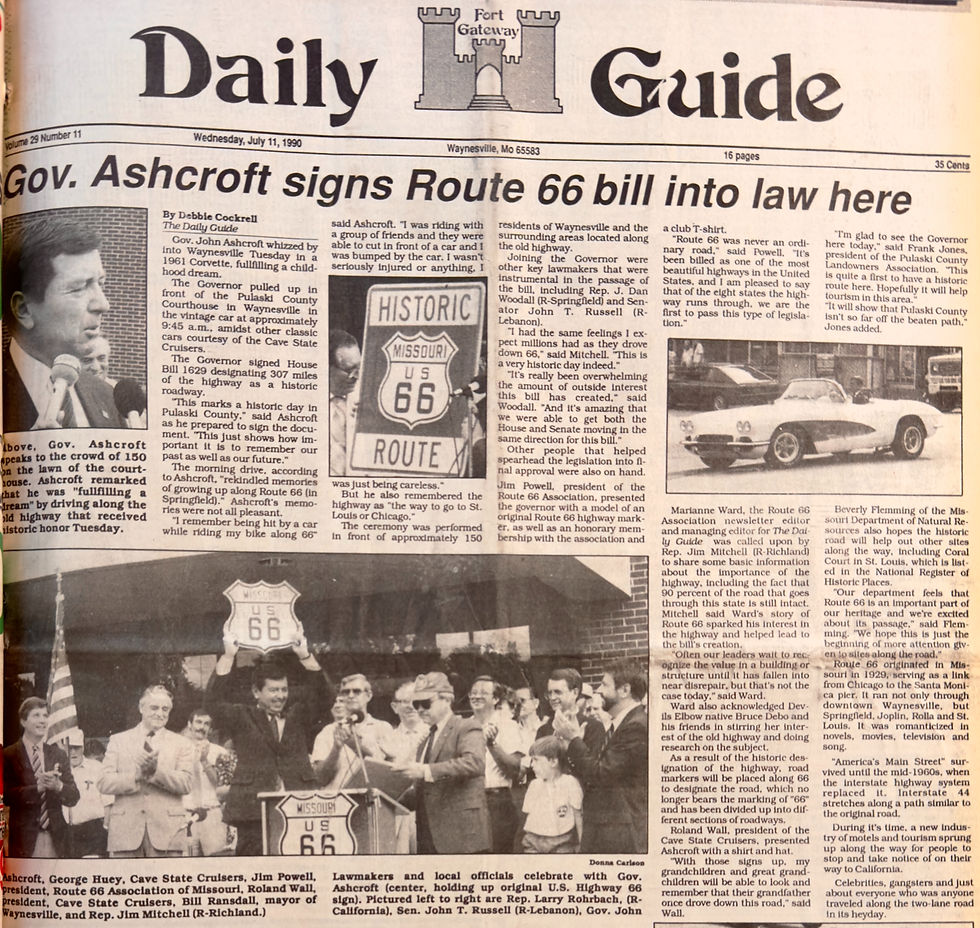
Six months later, on July 10, 1990, Waynesville's courthouse square witnessed a ceremony that would cement the town's place in Route 66 history forever. Governor John Ashcroft signed House Bill 1629 at the new courthouse, making Missouri the first state to designate Route 66 as a State Historic Route. That signing earned Waynesville the permanent title "Birthplace of the Byway"—a designation now featured prominently in the town's Route 66 heritage tourism efforts.

Museum Transformation (1990-Present): The historic 1903 courthouse found new purpose as the Pulaski County Museum, opening its doors to preserve and share the county's remarkable story. Remarkably, the building retains its original character: the oak ceiling with exposed rafters in the upstairs courtroom, the decorative spindle balustrade on the wooden staircase, even the original Century Single Phase Ceiling fan with wooden blades in the old county clerk's office. Nine themed rooms now tell Pulaski County's story—from the Trail of Tears and Civil War through the Frisco Railroad, Route 66, and Fort Leonard Wood's military legacy. Visitors from all 50 states and more than 50 countries have walked through these halls.
Significance & 2026 Connection: As Waynesville prepares for the 2026 Route 66 Centennial celebration, the 1903 courthouse stands as living proof of why historic preservation matters. It's one of only two period courthouses still standing on Missouri's Route 66—a rare architectural survivor that connects the Old Wire Road era to the interstate age. The building represents Pulaski County's dual significance: not just a place Route 66 passed through, but the location where Missouri led the nation in recognizing the Mother Road's cultural importance. Open Saturdays from 11:00 AM to 4:00 PM (May through October), the museum offers free admission and hands-on interaction with history. The courthouse that served county government for 87 years now serves as a bridge between Pulaski County's past and its future—a monument to the vision of those who built it and the dedication of those who saved it for generations yet to come.


Comments